If your child’s orthodontist has recommended a palate expander, you probably have questions. What does it actually do? Does it hurt? How long does it stay in? Is it really necessary?
These are exactly the right questions to ask and I want to give you honest answers.
I’m Dr. Clay Sims, a board-certified orthodontist. Palate expanders are one of the most commonly recommended early treatment appliances in orthodontics and also one of the most misunderstood. Here’s what you actually need to know.
What a Palate Expander Does
The upper jaw, called the maxilla, is actually made up of two halves joined together by a growth plate running down the middle called the midpalatal suture. In children, this suture is not yet fused. It’s cartilage, not bone. That means the two halves of the upper jaw can be gradually separated and widened before the suture closes.
A palate expander takes advantage of this window. The appliance applies gentle consistent pressure on the two sides of the upper jaw, slowly separating the two halves and stimulating new bone growth to fill the gap. Over weeks and months the upper jaw becomes wider.
Once the suture closes, which happens during puberty typically in the mid-teens, expansion becomes significantly harder and in adults requires surgery to achieve the same result. This is why the timing of expansion matters so much and why we recommend early evaluation starting at age 7.
Why a Wider Upper Jaw Matters
Widening the upper jaw isn’t just cosmetic. It addresses real functional problems that, left untreated, either get harder to correct or require more invasive intervention later.
Posterior crossbite with jaw shift. This is the most important indication for expansion. When the upper jaw is too narrow, the upper back teeth bite inside the lower back teeth instead of outside them. The jaw compensates by shifting to one side when biting down. Over time that shift can cause asymmetric jaw growth, facial asymmetry, and joint problems. Catching and correcting this with an expander at age 7 or 8 is straightforward. Trying to address it at 14 or 15 is significantly more difficult.
Crowding. A narrow upper jaw often doesn’t have enough room to accommodate all the permanent teeth. Widening the arch creates space and can sometimes eliminate or reduce the need for tooth extractions later in treatment.
Impacted teeth. When there isn’t enough room in the arch, teeth can become impacted, meaning stuck and unable to erupt into position normally. Creating space with an expander can allow impacted teeth, especially the upper canines, to come in on their own without surgical intervention.
Mouth breathing and airway issues. A narrow palate can contribute to restricted nasal breathing. When the upper jaw is widened the floor of the nasal cavity also widens, which can improve nasal airflow meaningfully. Patients and parents often notice real changes after expansion: less mouth breathing, less snoring, better sleep. For kids who have been chronic mouth breathers, the improvement can be dramatic.
A Note on Palate Expanders and Airway: What the Research Actually Says
Airway is a significant topic in orthodontics right now and parents are seeing a lot of information about it online. Some of it is well-grounded. Some of it is fear-based and not fully supported by evidence.
Here’s the honest summary of where the research stands.
RPE expansion with the six-year molars in place produces real skeletal changes. The midpalatal suture separates, new bone fills the gap, and the nasal floor widens. Studies have documented improvements in nasal airflow and reduced nasal airway resistance after this type of expansion. Some research shows improvements in pediatric sleep-disordered breathing. The evidence for airway benefit from properly timed RPE expansion is real, though researchers note that larger controlled studies are still needed to fully characterize the extent of those benefits.
What the research does not support is expansion in very young children, typically under 6 or 7, before the first permanent molars have erupted. In that age range, expansion appliances are primarily moving teeth outward rather than producing true skeletal change. The palatal suture at that age is not yet ready to respond to expansion forces the way it does once the six-year molars provide proper anchorage. Expansion done at age 3, 4, or 5 may produce some temporary changes in tooth position, but it is not achieving the skeletal widening that produces stable long-term results and meaningful airway improvement.
I bring this up because some providers, including certain dentists and pediatric dentists who market themselves as airway specialists, are recommending expansion in very young children with significant urgency. I understand why parents respond to that framing. Nobody wants to miss a window for their child. But the clinical evidence does not support skeletal expansion before the first permanent molars are in, and treating with urgency at 3 or 4 years old is not the same thing as treating at the right time.
If you’ve been told your young child urgently needs an expander and you have doubts, a second opinion from a board-certified orthodontist is always appropriate. There is no harm in getting one. See our post on when children should first see an orthodontist for more on what we evaluate at early visits and what actually warrants early intervention.
Types of Palate Expanders
There are several types of expanders and the right choice depends on your child’s specific situation.
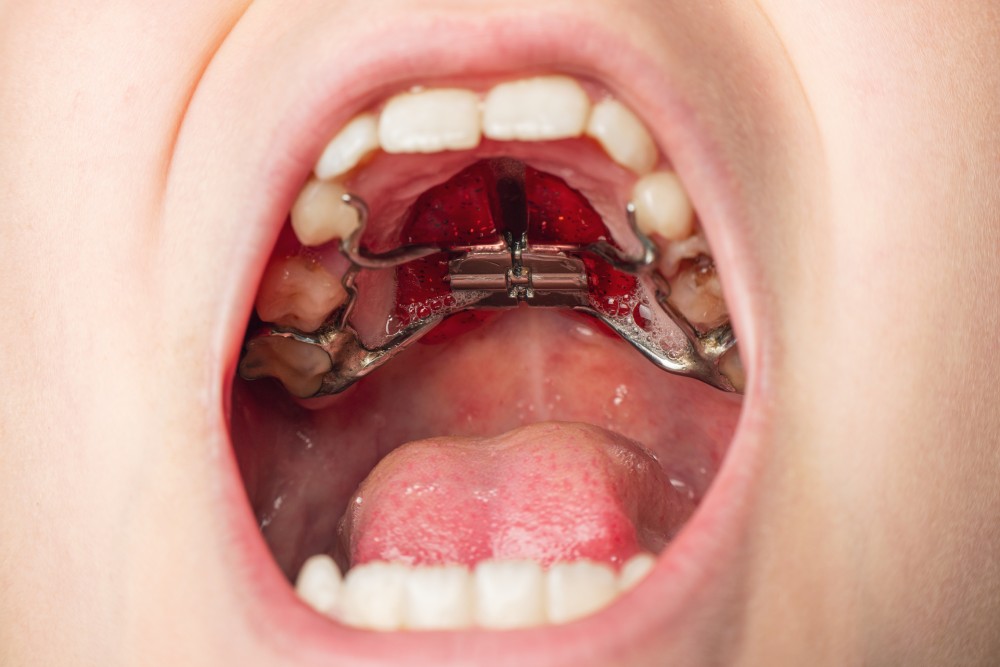
Rapid Palate Expander (RPE). The most commonly used expander for significant crossbites and jaw width deficiencies. It’s a fixed appliance bonded to the upper back teeth with a small key-activated screw in the middle. A parent turns the screw with a special key according to a schedule we provide, typically once a day for a set number of weeks. Each turn advances the two halves of the jaw a fraction of a millimeter. The total expansion period is usually 3 to 6 months, followed by a retention period where the expander stays in place while new bone fills the gap.
For cleft palate patients, we use a fan-shaped RPE rather than the standard parallel RPE. Cleft palate cases often have a V-shaped narrow arch that requires more expansion at the front than the back, and the fan design addresses that specific geometry. We work as part of the craniofacial and cleft palate team at Sacred Heart in Pensacola, so this is a case type we see and treat regularly.
Quad Helix. A wire-based fixed expander that applies gentler, more gradual force than the RPE. We use this for moderate crossbites and certain cases where a slower expansion pace is preferable. It doesn’t require turning. It works passively. It’s also used in complex treatment plans including some cleft palate cases.
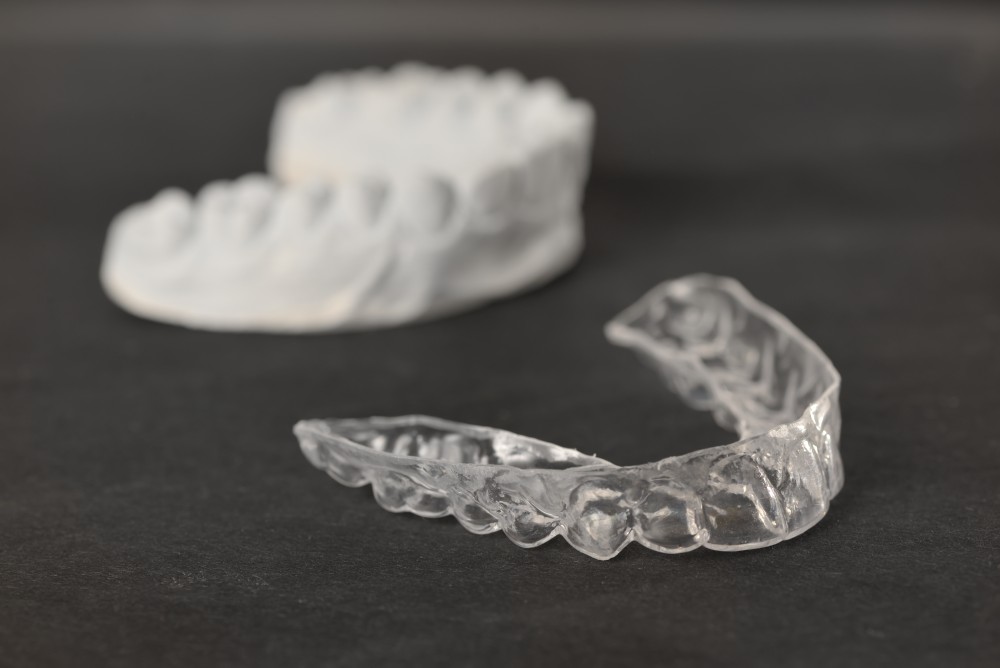
Invisalign Palatal Expander. A newer option that uses clear aligner-style appliances to achieve expansion with no metal in the mouth. It’s removable and more comfortable than traditional fixed expanders for some patients. Recent research published in Frontiers in Dental Medicine found that the Invisalign Palatal Expander produced midpalatal suture opening and skeletal expansion comparable to conventional RPE in mixed dentition patients with erupted first molars. We use it for specific cases where it’s appropriate, typically when the crossbite is moderate and compliance is reliable. For significant skeletal crossbites the fixed RPE remains the more predictable option.
Removable expanders. Used for minor dental expansion in cooperative patients. Less reliable than fixed appliances because the effect depends entirely on the patient wearing it consistently.
At our practice we use digital 3D scanning to take the records needed to fabricate expanders. No goopy impressions. The scanner captures a precise model of your child’s teeth in a few minutes.
What Age Is Best for a Palate Expander?
The ideal window for palate expansion is while the midpalatal suture is still open, which means before puberty. In practical terms, this is generally between ages 7 and 13 for most children, with the earlier part of that range being better for significant corrections.
The American Association of Orthodontists recommends that children have their first orthodontic evaluation by age 7, partly because this is when early problems like narrow arches and crossbites can first be diagnosed and addressed during the optimal treatment window.
We generally wait until the six-year molars have erupted before placing an RPE. Those molars provide the anchorage the expander needs to produce true skeletal expansion. In rare cases involving a severe posterior crossbite with a significant jaw shift, we may intervene before age 7 to correct the tooth position and eliminate the shift. That’s a more limited tooth-level correction rather than full skeletal expansion, but removing a damaging jaw shift early can prevent asymmetric jaw development down the road.
At 14 and older, the suture is beginning to fuse in most patients and expansion becomes less predictable. By adulthood, surgical expansion is the only reliable option. Surgically Assisted Rapid Palatal Expansion (SARPE) is performed in collaboration with an oral surgeon and can achieve skeletal expansion in adults who need it. It’s effective but significantly more involved than expansion in a growing child, which is exactly why addressing narrow arch problems early matters so much.
Does a Palate Expander Hurt?
This is one of the most common questions parents ask and children worry about.
Getting the expander placed doesn’t hurt. There’s no drilling or shots involved. The appliance is bonded to the back teeth the same way brackets are bonded.
After each activation, some kids feel a brief pressure sensation, often described as pressure across the nose or the roof of the mouth. This typically passes within five minutes. Many kids feel nothing at all. Over-the-counter pain relievers and soft foods take care of the minority who feel genuine soreness for a day or two after placement or adjustments.
A common and normal experience: a small gap will open between the two upper front teeth as expansion progresses. This looks alarming to parents and kids but it’s exactly what’s supposed to happen. It means the expansion is working. The gap closes on its own once the expander is turned off and the surrounding teeth settle.
Speech is temporarily affected in most patients for the first week or two. There’s often a slight lisp while the tongue adjusts to the appliance. This resolves on its own relatively quickly.
How Long Does a Palate Expander Stay In?
The active expansion phase, the period when the screw is being turned, typically runs 3 to 6 months depending on how much expansion is needed.
After active expansion is complete, the expander stays in place as a retainer for an additional 6 to 12 months. This retention phase is critical. New bone has to fill in the gap created by the expansion, and if the expander is removed too soon the jaw can narrow back down before the bone has fully formed. Patience during retention protects the investment made during expansion.
Total time in the appliance is usually 9 to 18 months from start to finish.
What Comes After the Expander?
An expander is almost always phase 1 treatment. It addresses a specific developmental issue before all the permanent teeth are in. Most children who go through expansion will still need full orthodontic treatment (braces or Invisalign) later once all the permanent teeth have erupted, typically at 11 to 13 years old.
The expansion creates the right foundation. Full treatment then aligns the teeth within that corrected foundation. Patients who skip the expansion and try to address everything at once in full treatment often end up with longer, more complicated cases and sometimes still need expansion at a less optimal age.
For a full explanation of how phase 1 and phase 2 treatment work together, see our post on two-phase orthodontic treatment.
What Can Go Wrong with a Palate Expander?
Parents ask about this and deserve a direct answer.
The expander can loosen or come off a tooth. This is uncommon but it happens, usually from eating foods that put stress on the bonded bands. Call us if this happens. It’s not an emergency but it needs to be addressed promptly so expansion isn’t lost.
Over-expansion. If the expansion schedule isn’t followed correctly or is continued too long, the jaw can be widened more than intended. This is why we give very specific instructions on activation and monitor progress at appointments.
Hygiene challenges. The expander creates additional surfaces that trap food and plaque. Thorough brushing around the appliance at every meal is important. We go over hygiene technique specifically for expanders at the delivery appointment.
Speech and comfort. Temporary speech changes and mild discomfort are normal and resolve on their own. These aren’t complications. They’re expected parts of the process.
What About Lower Jaw Expanders?
Parents sometimes ask whether the lower jaw can be expanded the same way. The short answer is no, and understanding why is useful.
The upper jaw has a midpalatal suture running down the middle, which is why expansion works. We’re separating two bones along a growth plate. The lower jaw, the mandible, is a single continuous bone. Its symphysis, the midline joint at the chin, fuses within the first year of life. There is no suture to open. True skeletal expansion of the lower jaw in a non-surgical patient is not possible.
What lower jaw appliances actually do is tip teeth outward. That’s dental movement, not skeletal expansion. The research on mandibular expanders confirms this clearly. Any changes produced are dentoalveolar, meaning they affect the teeth and surrounding bone, not the underlying jaw structure itself. And tipped teeth tend to relapse over time, which is why mandibular expanders have limited and controversial evidence supporting their use.
In practice, we almost never need a lower jaw expander. Here’s why. When we expand the upper jaw with an RPE, the lower jaw often responds by repositioning and widening passively to meet the corrected upper arch. After that, standard braces or aligners finish the job of aligning the lower teeth within their arch. The lower jaw also grows longer as a child develops, naturally creating more space for the lower teeth over time. Between passive adaptation after upper expansion, normal jaw growth, and braces or aligner treatment, we can address lower arch crowding and alignment without ever putting a bulky, uncomfortable appliance on the lower teeth.
Frequently Asked Questions
How do I know if my child needs a palate expander? You can’t know without an orthodontic evaluation. Signs that warrant a visit include a jaw that shifts to one side when biting down, upper teeth biting inside the lower back teeth, significant crowding, or concerns about mouth breathing. We see children starting at age 7 and the consultation is free.
What is the best age for a palate expander? Generally between ages 7 and 13, with earlier being better for significant corrections. The window closes as the midpalatal suture fuses during puberty.
Can a 14-year-old get a palate expander? Sometimes, yes. At 14 the suture is beginning to fuse but may not be fully closed depending on the individual’s development. Results are less predictable than in younger patients. An evaluation with X-rays can tell us whether expansion is still feasible.
Does palate expansion change facial appearance? It can, in subtle ways. Widening the upper jaw can broaden the smile, reduce the appearance of a narrow arch, and in some cases slightly change the midface appearance. These changes are generally positive and are a side effect of correcting a functional problem, not the goal of the treatment.
Do palate expanders affect speech permanently? No. Speech changes are temporary and typically resolve within a few weeks as the tongue adapts to the appliance. There is no permanent effect on speech.
How much does a palate expander cost? Expanders at our practice typically range from $1,500 to just over $2,000 depending on the type and what’s included. That covers the digital scan and records, the custom-fabricated appliance, all monitoring appointments, and retainers if needed. The Quad Helix is on the lower end of that range and the RPE is slightly higher.
The good news on cost: many dental insurance plans with orthodontic benefits will cover roughly half the cost of an expander when it’s part of a diagnosed treatment plan. That can bring the out-of-pocket cost down to $750 to $1,000 or less depending on your plan. We check your insurance benefits for free at your first appointment so you know exactly what your plan covers before committing to anything.
We also finance expander treatment at 0% interest spread over the length of treatment, typically 6 to 9 months, so the monthly cost is very manageable. We give exact pricing at your free consultation.
Will my child need braces after the expander? Most likely yes. An expander addresses a specific developmental problem. Full orthodontic treatment to align all the teeth typically follows once the permanent teeth are in. We offer a Phase 2 discount for patients who completed Phase 1 treatment with us.
Is a crossbite considered medically necessary? A posterior crossbite with jaw shift is generally considered a functional problem rather than purely cosmetic, and many insurance plans treat it accordingly. We check your insurance benefits at your first appointment and will tell you what your plan covers.
Schedule your child’s free orthodontic evaluation at Sims Orthodontics
Three locations in Pensacola, Gulf Breeze, and Crestview. No referral needed.
Sims Orthodontics serves families from Pensacola, Gulf Breeze, Crestview, Navarre, Pace, Milton, and across Northwest Florida.