Most parents aren’t orthodontists. You’re not supposed to know exactly what to look for when your child’s teeth are coming in. But there are signs, some obvious and some easy to miss, that tell you it’s time to call an orthodontist and get a professional opinion.
I’m Dr. Clay Sims, a board-certified orthodontist with three locations in Pensacola, Gulf Breeze, and Crestview. I’ve been practicing here since 2011 and I see kids at every stage of dental development. Some come in at exactly the right time. Others come in a few years later than ideal, and we spend part of that first appointment talking about what we could have done differently if we’d caught things sooner.
This post is about helping you recognize the signs early so you’re in the first group, not the second.
The Obvious Signs Most Parents Notice
Some signs are hard to miss once you know to look for them.
Crowded or crooked teeth. This is the most common reason parents call us. When permanent teeth come in and there clearly isn’t enough room, teeth overlapping, twisting sideways, coming in behind baby teeth that haven’t fallen out yet, that’s crowding and it almost always needs orthodontic attention.
Large gaps between teeth. Spacing issues are the opposite problem. Some gaps are normal and close on their own as other teeth come in. But persistent gaps, especially in older children, often indicate missing teeth, teeth that are too small for the jaw, or habits that are pushing teeth apart.
Teeth that protrude. Upper front teeth that stick out significantly, sometimes called buck teeth, are more than a cosmetic concern. Protruding teeth are more vulnerable to injury during sports and play, and they can affect how the upper and lower jaws relate to each other over time.
An underbite. When the lower front teeth sit in front of the upper front teeth, that’s an underbite. This one is worth catching early. Underbites related to lower jaw growth that isn’t being matched by the upper jaw can progress over time and become more difficult to treat. In some cases early intervention can reduce or eliminate the need for jaw surgery later.
An open bite. When your child bites down and the front teeth don’t touch, there’s a visible gap between the upper and lower front teeth even when the back teeth are closed. That’s an open bite. This is frequently connected to thumb sucking, finger sucking, or tongue thrust habits. The earlier the habit is addressed the better the chances of the open bite correcting itself as the jaw grows.
The Signs That Are Easier to Miss
These are the ones I want parents to pay closer attention to because they’re less obvious and more likely to get overlooked until the window for easy correction has passed.
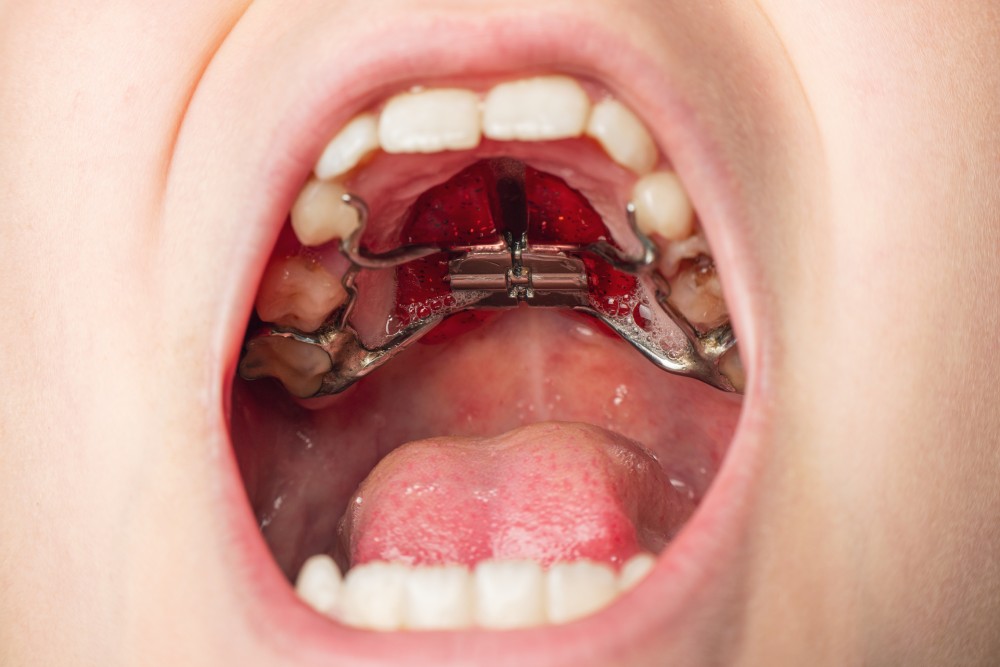
Your child shifts their jaw when they bite down. Watch your child close their teeth together naturally. If their jaw slides to one side when they bite, that’s a sign of a posterior crossbite. The upper back teeth are biting inside the lower back teeth and the jaw is compensating by shifting. Left untreated this can cause uneven jaw growth and facial asymmetry that becomes much harder to address after puberty. Caught early, it’s typically straightforward to fix with an expander.
Upper front teeth biting behind lower front teeth. One or two upper front teeth sitting behind the lower front teeth is called an anterior crossbite. Unlike a full underbite it can be subtle enough that parents don’t immediately notice it. But it causes wear on the edges of those teeth and can lead to gum recession on the lower front teeth over time. A simple appliance or short phase of early treatment can correct it cleanly at a young age.
Mouth breathing. Children who breathe primarily through their mouth, especially at night, may have a narrow upper jaw that isn’t allowing proper nasal breathing. This is worth evaluating by both a pediatrician and an orthodontist. Palate expansion can sometimes help and it’s much more effective in younger children whose palates haven’t fully fused.
A thumb, finger, or pacifier habit past age 4 or 5. These habits put sustained pressure on the developing teeth and jaw. Past age 4 or 5 they can start affecting tooth alignment and jaw development. Past age 7 or 8 they can cause open bites and jaw narrowing that are significantly harder to correct. If your child is still actively sucking their thumb past kindergarten age it’s worth bringing up at their next dental visit and considering an orthodontic evaluation.
Teeth that seem to be coming in at strange angles. Permanent teeth sometimes emerge rotated, tipped, or in entirely the wrong position. This often indicates crowding or a tooth that is impacted, meaning it doesn’t have a clear path to come in normally. Early identification gives us options. Waiting until all the teeth are fully in sometimes means those options are no longer available.
Baby teeth falling out much earlier or later than expected. Baby teeth typically fall out in a fairly predictable sequence starting around age 6. If a tooth falls out significantly earlier than expected, usually due to decay or injury, and no space maintainer is placed, neighboring teeth can drift into that space and block the permanent tooth from erupting correctly. If baby teeth are hanging on much longer than expected while the permanent tooth is already visible, that also warrants a visit.
What Parents Tell Me Finally Got Them to Call
I’ve asked parents this question more times than I can count. What made you finally make the appointment?
The single most common answer surprises people: their child stopped smiling. Not dramatically, not all at once. Parents start noticing it in photos, in videos, in everyday moments. Their kid covers their mouth when they laugh. They turn away from the camera. They make a comment about not liking their teeth. When a child starts holding back their smile, that’s the moment most parents pick up the phone. And honestly, that’s the right moment to call.
Beyond that, here’s what else I hear regularly:
Heavy crowding, especially on the lower teeth. Parents can see the teeth are stacking up and they’re worried about where it’s all heading.
A large gap between the two front teeth, what’s called a diastema. It’s one of the most noticeable things to parents and one of the most common reasons families come in earlier than they otherwise might have.
A child who seems dentally advanced or delayed for their age. Some 8-year-olds have nearly all their permanent teeth already. Some 13 or 14-year-olds still have 10 or 12 baby teeth. Neither of these is automatically a problem, but they understandably concern parents because they don’t match what they see in other kids. Dental age doesn’t always match chronological age and that’s completely normal. But it’s worth having an orthodontist explain what it means for your child specifically.
Grinding, mouth breathing, thumb sucking, tongue thrust. Parents notice these habits and either their dentist flags it or they start wondering what it means for how the teeth are developing.
A school photo. Every year I see a wave of consultations in the fall after school picture day. Parents see a photo and notice something they hadn’t been seeing up close every day.
Whatever gets you to call, the free consultation means there’s no cost to finding out where things stand. If everything looks fine I’ll tell you that. If there’s something worth addressing I’ll explain what it is, why it matters, and what the options are.
Does My Child Definitely Need Treatment If I Notice These Signs?
Not necessarily. Some of these signs resolve on their own as development continues. Others are significant enough that waiting makes them worse. The only way to know for certain is an evaluation by an orthodontist.
What I will tell you is that coming in early never hurts. The absolute worst outcome of an early evaluation is that I tell you everything looks fine and we don’t need to do anything yet. That’s a free piece of mind. The worst outcome of waiting is missing a window where a simple, relatively inexpensive intervention could have prevented something more complex and costly down the road.
We see kids starting at age 7 and our observation program monitors growth at no charge until the timing for treatment is right. See our full post on when children should first see an orthodontist for more detail on what we’re evaluating at those early visits.
A Quick Reference: Signs to Watch For by Age
Ages 4 to 6:
- Thumb, finger, or pacifier habit still active
- Noticeable jaw shifting when biting down
- Upper front teeth biting behind lower front teeth
- Teeth visibly crowded even with baby teeth
Ages 7 to 9:
- Any of the above plus:
- Permanent teeth coming in rotated or at unusual angles
- Baby teeth falling out much earlier or later than expected
- Mouth breathing, especially during sleep
- Gaps that seem to be widening rather than closing
Ages 10 to 13:
- Any of the above plus:
- Noticeable crowding as more permanent teeth come in
- Protruding upper front teeth
- Underbite or open bite
- Self-consciousness about smile starting to affect confidence
- Still has many baby teeth at 13 or 14 — dental age doesn’t always match chronological age and an orthodontist can tell you what it means for treatment timing
At any age, if something looks or feels off, it’s worth a call. The consultation is free and there’s no obligation.
One of the things I love most about what I do is that moment when a kid who came in barely smiling, covering their mouth and turning away from cameras, gets their braces on and something shifts. They start taking care of their teeth because they’re proud of them. They start smiling in photos. By the time we take the braces off, the person sitting in that chair is different. More confident. More themselves. That doesn’t happen if nobody noticed the signs and made the call.
Frequently Asked Questions
At what age do kids typically get braces? Full orthodontic treatment most commonly starts between ages 11 and 14, after most or all of the permanent teeth have come in. However, certain problems benefit from earlier intervention between ages 7 and 10. We evaluate each child individually and recommend treatment only when the timing is right for their specific situation.
How do I know if my child needs braces or just an expander? That’s exactly what an orthodontic evaluation is for. Some children need only an expander or a simple appliance to address a specific issue early. Others need full braces or Invisalign. Some need both in sequence. There’s no way to know without a clinical exam and X-rays.
My dentist said my child’s teeth look fine. Should I still come in? A dentist’s opinion is valuable but orthodontic evaluations look at different things than a routine dental exam. Bite relationships, jaw development, growth patterns, and eruption sequencing require orthodontic training to assess properly. There’s no harm in getting an orthodontic opinion even if your dentist hasn’t flagged anything. We provide free consultations and if everything looks good I’ll tell you so.
Does my child need braces if they only have a few crooked teeth? It depends on why the teeth are crooked and what’s happening with the bite and jaw development. Minor crowding sometimes resolves on its own. Other times it indicates a space problem that will get worse as more permanent teeth come in. An evaluation gives you a clear answer specific to your child’s situation.
What happens if we wait to see if the teeth straighten on their own? For some issues waiting is completely appropriate. For others, crossbites, underbites, habits, and space loss, waiting past a certain window makes treatment more complex and sometimes changes the outcome. The free consultation tells you which category your child is in.
How much does orthodontic treatment cost for kids? It ranges widely depending on what’s needed. A simple appliance can be under $1,000. Phase 1 early treatment runs $3,000 to $4,700. Full treatment is $6,000 to $7,500 before insurance and discounts. See our full post on braces costs in Pensacola for a complete breakdown including how insurance and payment plans work.
Schedule your child’s free orthodontic consultation at Sims Orthodontics
No referral needed. Locations in Pensacola, Gulf Breeze, and Crestview.
Sims Orthodontics serves families from Pensacola, Gulf Breeze, Crestview, Navarre, Pace, Milton, and across Northwest Florida.